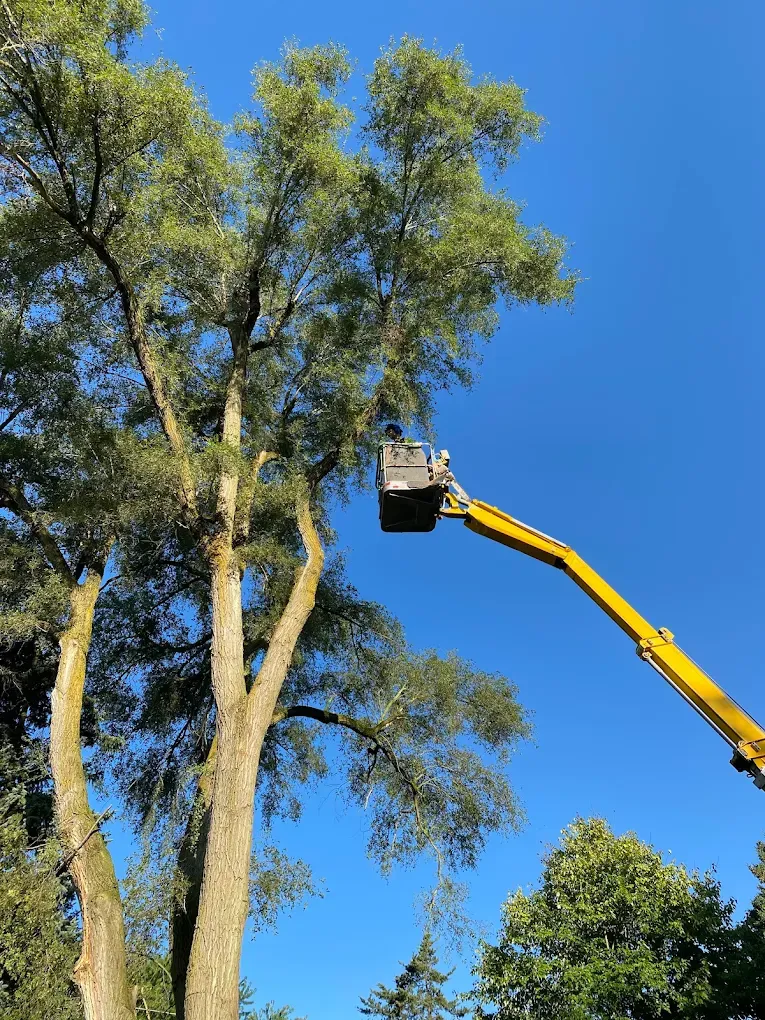
Tree Trimming & Pruning
Hazard limbs, handled.
Hazardous limbs, overgrown canopies, low branches scraping the roof, and preventative trimming before the next storm — that's our focus. Done right, your trees stay strong and your home stays safe.
What's included
Done right the first time.
- Hazardous & broken limb removal
- Overgrown canopy thinning
- Low branch & roof clearance
- Preventative storm-prep trimming
- Deadwood removal
- Power-line clearance work
Our process
How the job gets done.
- 01
Tree health check
We assess each tree — structure, deadwood, hazards, and clearance issues.
- 02
Pruning plan
Clear written quote with what gets cut, what stays, and why.
- 03
Precision cuts
Industry-standard pruning. Climbed, never spiked, on living trees.
- 04
Cleanup
Limbs chipped, wood hauled or cut to firewood lengths if you want it, yard left clean.
Why proper pruning matters more than you think
Most of the tree problems we get called out for could have been prevented with a single, well-timed pruning. A crossing limb that wasn't removed in year five becomes a split crotch that takes out half the tree in year fifteen. A heavy lateral branch that wasn't shortened becomes the limb that drops on your roof during the next ice storm. Deadwood that was left in the canopy becomes the falling missile that hurts somebody. Pruning isn't cosmetic — it's structural. Done correctly, it adds decades of safe life to a tree. Done poorly, it kills the tree slowly and creates new hazards in the process.
That's why every tree we trim is approached as a long-term relationship, not a one-time haircut. Tom looks at the structure of the tree first — where the main scaffold limbs are, where the weak unions live, where the canopy is fighting itself for light. Then he plans the cuts. We follow ANSI A300 pruning standards (the industry standard for proper tree care), which means we never remove more than about 25% of a healthy canopy in a single season, we make clean cuts at the branch collar, and we never "top" or "lion-tail" a tree just because it's faster.
If you've been quoted by a contractor who wants to top your tree — cutting all the leaders flat across the top — get a second opinion. Topping is one of the most damaging things you can do to a tree. It triggers a panic response of weak, fast-growing water sprouts, opens the trunk to decay, and turns a long-lived shade tree into a future hazard removal. We won't do it. There's almost always a better solution, and we'd rather lose the job than damage your tree.
What we trim and when
We prune everything from 80-foot oaks to dwarf apple trees. Most of our work falls into a few categories. Crown cleaning is the routine removal of dead, dying, broken, or diseased branches throughout the canopy — the single best thing you can do for a mature shade tree. Crown thinning selectively removes live branches to let light and wind pass through, which reduces the sail effect during storms and helps the rest of the canopy stay healthy. Crown raising lifts the lowest branches to give clearance for cars, mowers, walkways, or sight lines. Crown reduction shortens overall height or spread, used carefully on trees that have outgrown their space.
Timing matters. For most hardwoods in Michigan, late winter through early spring (before bud-break) is the ideal window — the tree is dormant, you can see structure clearly, and the wounds heal quickly when growth resumes. Storm-damage and hazard cuts can and should be done any time of year — a broken branch hanging in a tree is more dangerous than the small stress of an off-season cut. We'll tell you what's right for your specific tree during the estimate.
Cleanup is part of every trimming job. We chip the limbs, haul the brush, and if you want the larger wood cut to firewood lengths we'll cut and stack it before we leave. Your yard ends up cleaner than it was when we showed up.
Warning Signs
When to call us right away.
Trees give a lot of warning before they cause problems. If you notice any of these on your property, schedule a free trimming assessment before the next storm season.
- Branches touching or rubbing against the roof, siding, or windows.
- Limbs that have died back at the tips, lost their bark, or look gray and brittle.
- Heavy, unbalanced canopies that lean toward the house, driveway, or play area.
- Tight, V-shaped unions where two trunks fork — these split under ice and wind loads.
- Branches growing into power lines or service drops.
- A canopy so dense you can't see daylight through it (it needs thinning).
- Storm-broken limbs hanging in the canopy — these are called "hangers" and can fall any time.
Pricing
What affects the price.
Trimming pricing depends on the size of the tree, number of trees, access, difficulty, cleanup, power lines, and proximity to structures. We don't quote sight-unseen — every job gets a free on-site estimate with a written number.
Tree size
A small tree might be a one-hour job. A mature oak with full crown work is a half day with two climbers.
Number of trees
Multiple trees on the same trip are usually cheaper per tree than a single one-off.
Scope of pruning
Removing a few hazard branches costs less than a full crown clean and thin.
Access & climb
Trees we can reach from a lift cost less than ones we have to climb with ropes.
Cleanup
Hauling all the wood costs more than chipping brush and leaving rounds. Firewood-cut and stacked is in between.
Power lines & structures
Trees over houses, near service drops, or on slopes need extra rigging and time.
FAQs
Questions we hear a lot.
- What's the best time of year to trim my trees? +
- For most hardwoods, late winter through early spring is ideal — before bud-break and while the structure is visible. Hazard and storm cuts can be done any time.
- How much trimming is too much? +
- We follow industry best practices and never remove more than about 25% of a healthy canopy in one season. Anyone who tells you to cut more is risking the long-term health of your tree.
- Will my tree look weird after pruning? +
- A properly pruned tree should look almost exactly the same — just lighter, cleaner, and better balanced. If your last "trim" left big stubs and a flat top, that wasn't pruning. That was topping, and it's something we'd never do.
- Do you trim while the tree has leaves? +
- Yes — summer pruning is fine for most trees, especially for hazard limbs and clearance work. We just avoid heavy structural pruning during the hottest stretch of summer when trees are stressed.
- Can you trim around power lines? +
- We trim near service drops to your house, but the high-voltage primary lines along the road are the utility's responsibility. We're happy to coordinate with them if needed.
- Will pruning hurt my tree? +
- Proper pruning helps your tree. Improper pruning hurts it. The difference is technique, timing, and how much is removed. That's why hiring a real tree company instead of a handyman with a chainsaw matters.
Safety first
Trained, insured, careful.
Every TNT crew member follows strict safety protocols. We protect our team, your property, and your peace of mind on every job.
- Industry-standard pruning practices
- Trained climbing crew
- Power-line aware operators
- Property protection on every job
- Fully licensed & insured — protects you, the homeowner
- No subcontractors — our crew, every job
More services
Other ways we can help.
Where we work
Tree Trimming & Pruning across Lapeer, Genesee, Macomb, Oakland & St. Clair Counties.
Ready when you are
Got a tree problem?
We'll handle it — fast.
Free, no-pressure estimates. Same-week scheduling. 24/7 emergency response across Lapeer, Genesee, St. Clair, Oakland & Macomb Counties.